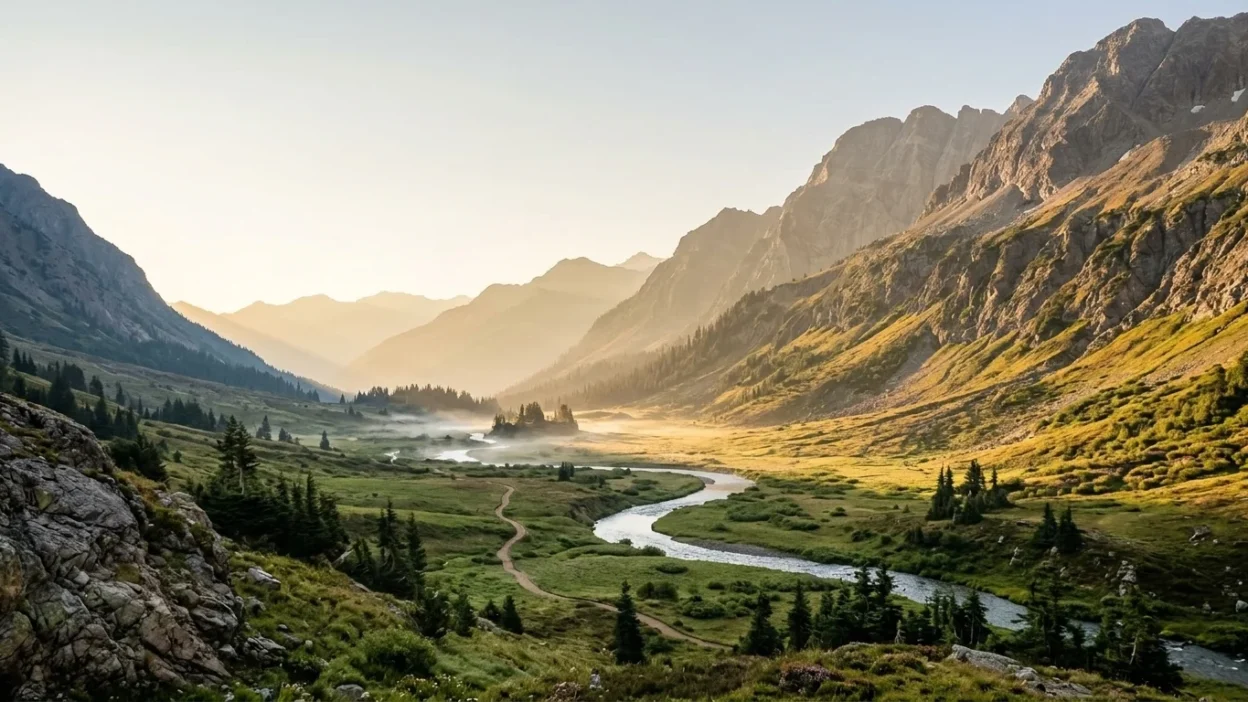
Valley symbolism is often connected with peace, humility, shelter, reflection, transition, renewal, and personal growth. A valley lies between higher landscapes, creating a natural image of moving through low points before rising again.
Because valleys can provide protection, fertile soil, flowing water, and quiet spaces, they carry meanings that are both practical and emotional. A valley may represent rest after struggle, a period of uncertainty, or a peaceful place where growth can begin.
Understanding valley symbolism can offer insight into spirituality, dreams, literature, relationships, nature, and the challenges people experience throughout life.
Valley Symbolism Meaning (Clear Definition)
Valley symbolism refers to the ideas and meanings associated with valleys based on their natural characteristics, cultural traditions, spiritual imagery, and personal experiences.
At its simplest, a valley can symbolize a low or transitional point in life. Unlike a mountain peak, which often represents achievement, a valley can represent the quieter stages of a journey.
However, being in a valley does not necessarily mean failure. Valleys can be fertile, sheltered, peaceful, and full of life. They can represent a necessary period of rest, preparation, reflection, or renewal.
Common meanings of valley symbolism include:
- Peace – a quiet place away from noise and pressure.
- Humility – being grounded rather than seeking a higher position.
- Shelter – protection from harsh external conditions.
- Reflection – a time to look inward and understand experience.
- Transition – moving between one stage of life and another.
- Renewal – recovering energy and beginning again.
- Growth – developing through difficult or uncertain periods.
- Hope – remembering that valleys can lead toward higher ground.
The meaning of a valley depends strongly on its appearance and context. A green valley with flowing water may suggest abundance and renewal, while a dark or barren valley may symbolize loneliness, uncertainty, or emotional struggle.
What Does Valley Symbolism Represent?
Valley symbolism represents the lower, quieter, and often transformative stages of a journey.
One of its strongest meanings is humility. Valleys sit below surrounding mountains, creating a natural contrast between height and depth. Symbolically, this can remind us that life is not always about reaching the highest position.
A valley can also represent shelter. Mountains surrounding a valley can protect it from certain environmental conditions, making the valley a natural place of refuge.
Another important meaning is growth. Many valleys contain rivers, fertile soil, forests, farms, and diverse ecosystems. This makes the valley a powerful symbol of how life can flourish even in places that appear low or enclosed.
| Valley Symbolism | Common Meaning |
|---|---|
| Peace | Rest, quiet, and emotional calm |
| Humility | Staying grounded and realistic |
| Shelter | Safety and protection |
| Reflection | Self-examination and understanding |
| Transition | Moving between life stages |
| Renewal | Recovery and fresh beginnings |
| Growth | Development through experience |
| Hope | The possibility of rising beyond difficulty |
The valley can therefore represent more than hardship. It can symbolize a meaningful stage of life in which a person gathers strength before moving forward.
Spiritual Meaning of Valley Symbolism
Spiritually, valley symbolism is often associated with humility, inner reflection, spiritual testing, renewal, surrender, and transformation.
A valley can represent a period when life feels uncertain or when a person is forced to slow down. Such experiences may encourage deeper reflection and a greater awareness of what truly matters.
Unlike a mountain peak, where the landscape opens dramatically around you, a valley can feel enclosed. Symbolically, this can represent an inward journey.
The valley may encourage a person to:
- Accept periods of uncertainty without assuming they will last forever.
- Use quiet periods for reflection.
- Remain humble during both success and difficulty.
- Find meaning in ordinary experiences.
- Recover before beginning another demanding journey.
- Trust that difficult stages can lead to new growth.
Spiritual valley symbolism also highlights the value of stillness. Not every meaningful stage of life requires constant movement. Sometimes growth occurs while a person is resting, reflecting, healing, or simply learning to remain present.
The valley can therefore represent a sacred pause between one chapter and the next.
Biblical / Religious Meaning of Valley Symbolism
Valleys have significant symbolic importance in the Bible and other religious traditions. Biblical valleys can represent struggle, testing, danger, fertility, refuge, judgment, and spiritual transformation, depending on the specific passage.
One of the most familiar examples is Psalm 23, which refers to walking through “the valley of the shadow of death.” In this context, the valley represents a frightening or difficult passage, while the surrounding message emphasizes guidance and divine presence.
This imagery contributes to a broader religious understanding of valleys as places where people may experience hardship without being abandoned.
Biblical valleys are not always associated with suffering, however. Valleys can also be fertile and productive places. Their water and soil can support agriculture and communities.
This creates an important religious symbolism: a low point can be difficult while still containing the conditions necessary for future growth.
Religious interpretations should always be understood in their specific textual and cultural context. A valley does not have one fixed meaning across every passage or tradition.
Valley Symbolism in History and Culture
Valleys have shaped human civilization because they often provide the natural resources needed for settlement.
Many communities developed around valleys because rivers, fertile soil, and relatively sheltered landscapes could support agriculture and trade.
As a result, valleys became associated with home, nourishment, community, fertility, and abundance.
At the same time, mountain valleys often served as routes through difficult landscapes. A valley could provide a natural pathway between highlands, connecting different communities and regions.
Culturally, valleys also became associated with distinctive landscapes and identities. Famous valleys around the world have inspired traditions, tourism, agriculture, art, and storytelling.
Their symbolism often reflects their physical character. A fertile valley may suggest abundance, while a remote valley may suggest solitude and mystery.
Valleys therefore represent an interesting combination of protection and transition. They can provide shelter while also serving as pathways toward somewhere else.
Valley Symbolism in Literature and Art
Valleys have long appeared in poetry, novels, paintings, photography, and film as symbols of emotional and spiritual states.
A character traveling through a valley may be experiencing a difficult stage of life. The landscape can mirror feelings of uncertainty, loneliness, or vulnerability.
Yet valleys can also represent safety. A character who has survived a difficult journey may enter a peaceful valley and experience rest or renewal.
Artists frequently use the contrast between mountains and valleys to communicate emotional depth. High peaks can symbolize ambition or achievement, while valleys can represent reflection, humility, or struggle.
The changing light within a valley can also create powerful artistic imagery. Morning mist may suggest mystery or uncertainty, while sunlight breaking through clouds can symbolize hope.
In literature, the valley can therefore function as both a physical location and an emotional landscape.
Dream Meaning of Valley Symbolism
Dreaming about a valley can have several symbolic interpretations depending on the landscape, emotions, and events within the dream.
A green valley may represent renewal, peace, emotional healing, abundance, or a fresh stage of growth.
A dark valley may reflect uncertainty, loneliness, fear, or a difficult period in waking life.
Walking through a valley can symbolize a transition or journey through an unfamiliar stage of life.
Standing in a peaceful valley may represent a need for rest, safety, reflection, or emotional balance.
Climbing out of a valley can symbolize overcoming difficulties and moving toward greater confidence or clarity.
Looking down into a valley from a mountain may suggest gaining perspective on past experiences or seeing a difficult period from a new viewpoint.
Dream interpretation is personal rather than predictive. Your emotions within the dream and your current circumstances often provide more meaningful clues than the landscape alone.
Modern Meaning of Valley Symbolism
In modern life, valley symbolism often represents the difficult middle stages of personal growth.
People sometimes imagine success as a straight upward path. Valley symbolism offers a different perspective: life naturally moves through peaks and low points.
A career setback, relationship difficulty, period of uncertainty, or personal transition can feel like entering a valley. Yet such periods may provide opportunities for reflection and preparation.
The valley can also represent balance. Constant achievement is exhausting, and a life made entirely of peaks would leave little room for rest.
Valley Symbolism in Love and Relationships
In relationships, a valley can symbolize shared challenges, emotional vulnerability, healing, patience, and renewal.
Couples may go through difficult periods that test communication and trust. Working through those periods can sometimes create a stronger understanding of one another.
The valley can also symbolize emotional intimacy because people often become more vulnerable during difficult experiences.
However, not every relationship difficulty needs to be endured indefinitely. Valley symbolism should not be used to romanticize harmful or unhealthy circumstances.
The Shadow Side of Valley Symbolism
Valleys can carry challenging meanings as well.
They may represent isolation, discouragement, uncertainty, emotional heaviness, or feeling stuck.
A person who remains focused only on the low point may struggle to recognize that circumstances can change.
There is also a risk of viewing every difficult experience as automatically meaningful. Some hardships are simply painful, and acknowledging that reality is part of honest reflection.
The deeper lesson is not that every valley is easy or necessary. It is that a difficult stage does not have to define an entire life.
What Valley Symbolism Can Teach Us
Valley symbolism offers several useful lessons about life and personal growth.
Low points are part of the journey. A difficult stage does not necessarily represent the end of progress.
Rest has value. Valleys can provide shelter and quiet after demanding periods.
Growth can happen below the peak. Fertile valleys remind us that meaningful development does not require constant achievement.
Perspective takes time. Experiences that seem confusing in the moment may become clearer later.
Stay humble. Success and difficulty are both temporary parts of a larger journey.
Look for renewal. Rivers, plants, and communities often flourish in valleys, showing how life can emerge in unexpected places.
Keep moving when you are ready. A valley can be a place of rest without becoming a permanent destination.
Frequently Asked Questions About Valley Symbolism
What is the main meaning of valley symbolism?
Valley symbolism commonly represents peace, humility, shelter, reflection, transition, renewal, growth, and hope. It can also symbolize difficult or uncertain periods in life.
What does a valley symbolize spiritually?
Spiritually, a valley can represent humility, reflection, spiritual testing, renewal, and transformation. It may symbolize a quiet period in which a person develops deeper awareness.
What does a valley mean in dreams?
A valley in a dream may symbolize a transition, emotional low point, need for rest, or period of personal growth. The landscape and emotions within the dream help determine its personal meaning.
What does a green valley symbolize?
A green valley often symbolizes renewal, peace, fertility, abundance, healing, and new growth. Its natural life can represent hope after a difficult period.
What does a valley symbolize in love?
In relationships, a valley can symbolize shared challenges, vulnerability, patience, healing, and emotional growth. It may represent a difficult stage that requires communication and mutual support.
Conclusion
Valley symbolism reminds us that life is not defined only by its highest points. Valleys can represent difficult seasons, but they can also provide shelter, reflection, nourishment, and renewal.
A valley may be a place between two peaks, yet it can hold its own beauty and purpose. Sometimes the quieter stages of life are where the deepest roots of growth begin.

Gabriel Santiago is a dedicated writer and symbolism researcher at BibloSign.com, passionate about exploring symbol meanings, cultural traditions, spiritual interpretations, and historical significance to help readers better understand the world of symbolism.