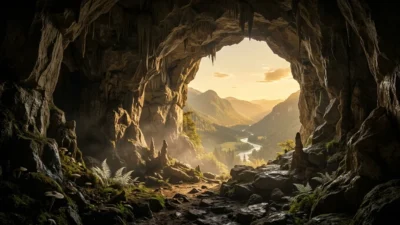
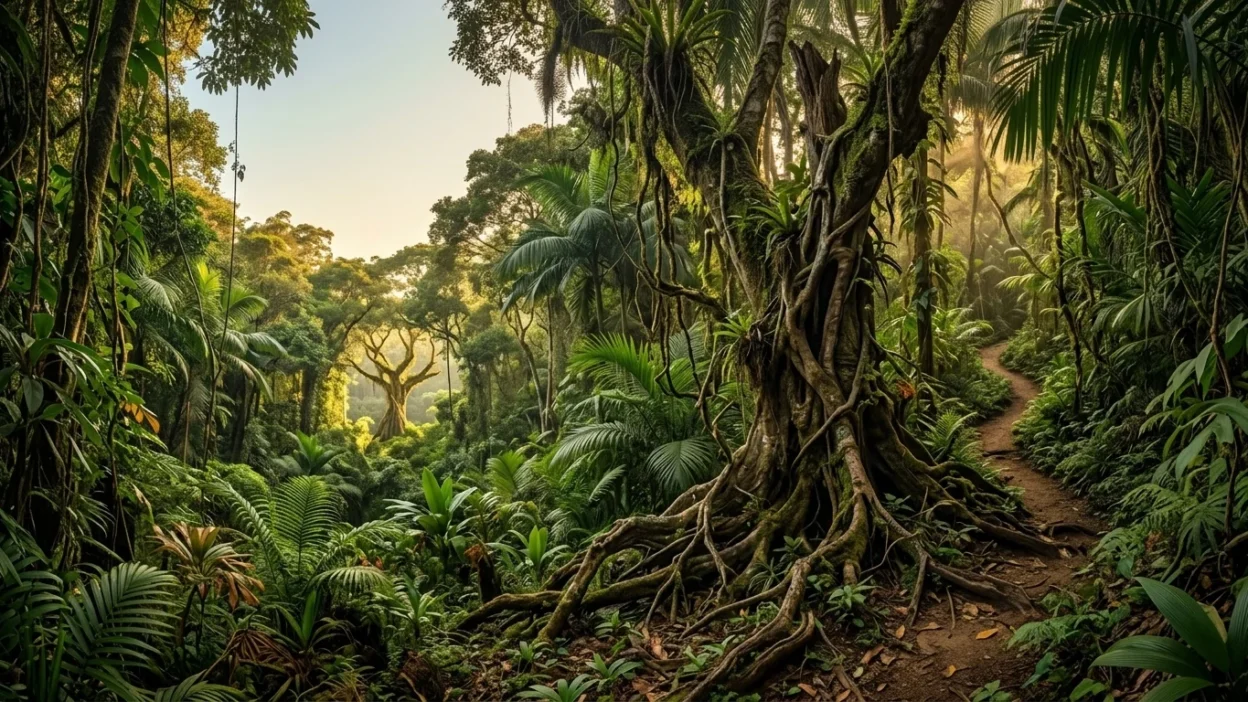
Jungle symbolism often represents mystery, adventure, survival, growth, transformation, and the unknown parts of life. A jungle is dense, alive, unpredictable, and full of hidden paths. Because of these qualities, it has become a powerful symbol in spirituality, literature, dreams, art, and modern culture.
Unlike a quiet forest, a jungle can feel more intense and untamed. It may represent a place where ordinary rules seem less certain and instinct becomes important. At the same time, its rich plant and animal life can symbolize abundance, creativity, renewal, and the strength of nature.
Jungle Symbolism Meaning (Clear Definition)
Jungle symbolism refers to the meanings people associate with dense, wild, and largely untamed natural environments. At its heart, the jungle symbolizes the unknown, survival, instinct, mystery, growth, transformation, and freedom.
A jungle contains both beauty and danger. It can provide shelter and nourishment while also presenting obstacles and uncertainty. This contrast makes it a useful symbol for complicated experiences in human life.
Common meanings of jungle symbolism include:
| Jungle Symbol | Symbolic Meaning |
|---|---|
| Dense vegetation | Complexity and mystery |
| Hidden paths | The unknown and personal discovery |
| Wild animals | Instinct, strength, and primal nature |
| Thick canopy | Protection, mystery, and hidden knowledge |
| Tropical growth | Abundance and vitality |
| Dangerous terrain | Challenges and uncertainty |
| Clearings | Understanding, hope, and revelation |
| Vines and roots | Connection, persistence, and interdependence |
| Rain | Renewal and emotional cleansing |
The jungle can therefore symbolize both external challenges and the unexplored landscape within a person.
What Does Jungle Symbolism Represent?
Jungle symbolism can represent several important themes. Its meaning often depends on the surrounding context and the person’s own experiences.
Mystery and the Unknown
A jungle hides much of what exists within it. Dense leaves, shadows, winding paths, and unfamiliar sounds create a sense of mystery.
For this reason, the jungle can represent situations where the future is unclear. Entering a jungle may symbolically mean entering an unfamiliar stage of life.
Survival and Resilience
Life in a jungle requires adaptation. Plants compete for light, animals search for food, and every organism responds to changing conditions.
This makes the jungle a strong symbol of survival and resilience. It can remind us that strength is sometimes expressed through patience, flexibility, and the ability to adapt rather than through force alone.
Growth and Abundance
Jungles are associated with extraordinary biological richness. Their dense vegetation can symbolize life expanding in many directions.
Jungle symbolism may therefore represent personal growth, creativity, opportunity, fertility, and abundance.
Instinct and Freedom
The wildness of a jungle can symbolize the part of human nature that exists beyond social rules and expectations. It may encourage a person to reconnect with instinct, intuition, independence, and authentic desires.
Transformation
Moving through a jungle often involves uncertainty before reaching a destination. Symbolically, this can represent a transformative journey.
A person may enter the metaphorical jungle confused or afraid and emerge with greater confidence, wisdom, or self-understanding.
Spiritual Meaning of Jungle Symbolism
Spiritually, jungle symbolism can represent a journey into the deeper parts of the self. Its darkness and complexity may reflect questions, fears, desires, and truths that are not always visible in everyday life.
The jungle can symbolize spiritual exploration because it contains both concealment and discovery. A hidden path may represent a new direction, while a clearing may symbolize insight after a period of uncertainty.
Its abundant life can also suggest the interconnectedness of creation. Trees, plants, insects, birds, animals, soil, water, and sunlight depend on one another.
This interconnectedness can inspire a spiritual understanding that individual life is part of something much larger.
The jungle may also symbolize surrender. Not everything can be controlled in a wild environment. Sometimes its message is to stop demanding complete certainty and learn to move forward with awareness and trust.
Biblical / Religious Meaning of Jungle Symbolism
The Bible does not establish one universal symbolic meaning for jungles. In biblical contexts, wilderness, forests, deserts, mountains, and other natural landscapes are more commonly discussed than the modern idea of a tropical jungle.
However, religious symbolism can still draw broader lessons from wild and untamed environments.
A dense wilderness may represent testing, uncertainty, isolation, spiritual searching, or dependence on divine guidance. Biblical stories frequently use challenging natural environments as settings in which people face hardship, make important decisions, or experience spiritual transformation.
Forests and trees also carry important biblical imagery. Trees can represent life, knowledge, prosperity, righteousness, or human flourishing depending on the passage and context.
Because of this, jungle symbolism in a religious or spiritual interpretation is best understood as a modern symbolic extension rather than a fixed biblical doctrine.
Jungle Symbolism in History and Culture
Throughout history, dense natural environments have often been viewed with a mixture of fascination, respect, fear, and curiosity.
For communities living in or near tropical ecosystems, the jungle is not simply a mysterious wilderness. It can be a source of food, medicine, materials, shelter, spiritual traditions, and cultural identity.
This distinction matters. Popular stories sometimes portray jungles only as dangerous and unexplored places, while Indigenous and local communities may possess extensive knowledge of their ecosystems.
The jungle can therefore symbolize both nature’s power and humanity’s relationship with the natural world.
In cultural storytelling, jungles are frequently associated with exploration and adventure. Hidden temples, unfamiliar animals, ancient ruins, and mysterious pathways have made jungle settings popular in legends, films, novels, and visual art.
At the same time, modern environmental awareness has given the jungle another important meaning: ecological protection. Tropical forests can symbolize biodiversity, environmental responsibility, and the delicate balance between human activity and nature.
Jungle Symbolism in Literature and Art
Jungles have long provided writers and artists with powerful settings for exploring human nature.
In literature, the jungle may represent a world outside ordinary civilization. Characters entering it often encounter unfamiliar environments that challenge their assumptions, courage, or identity.
The jungle can also function as a psychological landscape. Its darkness may represent fear, while its hidden paths may suggest uncertainty. A clearing can symbolize understanding, and a journey through dense vegetation can represent personal transformation.
Artists may use jungle imagery to communicate abundance, mystery, danger, freedom, or the overwhelming power of nature.
The contrast between dense foliage and shafts of sunlight can be especially meaningful. Darkness and light together may suggest that uncertainty and understanding can exist within the same experience.
Jungle imagery can also challenge the idea that humans stand separate from nature. The sheer complexity of the ecosystem reminds viewers that life is interconnected.
Dream Meaning of Jungle Symbolism
Dreaming about a jungle may symbolize an unfamiliar situation, emotional complexity, personal growth, or a desire to explore something hidden within yourself.
The meaning depends heavily on the details of the dream.
- Walking through a jungle: You may be navigating an uncertain period or exploring a new direction.
- Being lost in a jungle: This can symbolize confusion, lack of direction, or feeling overwhelmed.
- Finding a clear path: It may represent growing clarity or discovering a solution.
- Seeing wild animals: Animals may represent instinct, fears, strengths, or qualities you are learning to recognize.
- A peaceful jungle: This may reflect harmony with yourself or a desire for greater connection with nature.
- A dark or threatening jungle: It can symbolize anxiety, uncertainty, or an unresolved challenge.
- Discovering a hidden clearing: This may represent hope, insight, relief, or emotional renewal.
- Climbing through dense vegetation: It can suggest perseverance and progress despite obstacles.
Dream symbolism is personal rather than predictive. A jungle dream does not automatically predict future events. Your emotions during the dream and your current life circumstances are often more meaningful than any universal interpretation.
Modern Meaning of Jungle Symbolism
Today, jungle symbolism continues to appear in environmental discussions, personal development, entertainment, fashion, photography, and popular culture.
The jungle can symbolize the complexity of modern life. Work, relationships, technology, responsibilities, and constant information can sometimes feel like a dense environment that is difficult to navigate.
In this sense, finding a path through the jungle can represent creating clarity within complexity.
The jungle also represents environmental awareness. Tropical forests are among the world’s most biologically rich ecosystems, so their imagery can evoke conservation, biodiversity, sustainability, and respect for natural systems.
On a personal level, jungle symbolism can encourage people to embrace uncertainty rather than always trying to eliminate it. Growth often happens when a person enters unfamiliar territory.
Jungle Symbolism in Love and Relationships
In relationships, jungle symbolism can represent passion, emotional complexity, adventure, intimacy, and the unknown.
A relationship may sometimes feel like entering a dense landscape where every path reveals something new about another person. This can be exciting, but it can also require patience and communication.
A thriving jungle may symbolize a relationship full of life and growth. Interconnected roots and vines can suggest emotional bonds, while a difficult path may represent challenges that partners must navigate together.
The shadow side is confusion. A jungle can also symbolize relationships where emotions become tangled, boundaries are unclear, or one person feels lost.
The most useful interpretation depends on whether the jungle feels safe, threatening, peaceful, or overwhelming.
The Shadow Side of Jungle Symbolism
Jungle symbolism is not always positive.
Because jungles can be dense and difficult to navigate, they may symbolize confusion, fear, isolation, danger, emotional overwhelm, or a lack of direction.
The jungle’s wildness can also represent uncontrolled impulses. In some contexts, it may symbolize situations where instinct overwhelms reason.
However, these meanings do not necessarily represent failure. Difficulty can reveal areas that need attention.
A symbolic jungle may simply be showing that something in life needs patience, better boundaries, deeper awareness, or a clearer path forward.
What Jungle Symbolism Can Teach Us
The jungle offers several practical lessons about life.
Adaptation matters.
The natural world constantly changes. Learning to adapt can help us respond to challenges without losing our sense of direction.
Growth is rarely simple.
Jungle vegetation grows through competition, connection, and constant change. Personal development can also involve setbacks, unexpected turns, and periods of uncertainty.
Not everything needs immediate clarity.
A jungle reminds us that sometimes the next step becomes visible only after we take the first one.
Instinct deserves attention.
Intuition can provide useful information, especially when combined with thoughtful judgment and experience.
Connection creates strength.
Jungle ecosystems demonstrate how countless forms of life depend on one another. Human beings also benefit from relationships, communities, and mutual support.
There can be life within difficult places.
Even environments that appear intimidating can contain extraordinary beauty and vitality. Difficult seasons may similarly contain opportunities for learning and renewal.
Frequently Asked Questions About Jungle Symbolism
What is the main meaning of jungle symbolism?
Jungle symbolism commonly represents mystery, survival, growth, transformation, instinct, resilience, and the unknown. Its meaning changes according to the context.
What does a jungle symbolize spiritually?
Spiritually, a jungle can represent inner exploration, uncertainty, spiritual growth, interconnectedness, and a journey toward deeper self-understanding.
What does dreaming about a jungle mean?
A jungle dream may symbolize confusion, exploration, personal growth, or an unfamiliar life situation. The emotions and specific details of the dream are important to its interpretation.
What does a jungle symbolize in love?
In love, a jungle can represent passion, adventure, emotional complexity, intimacy, and the process of discovering another person. It can also symbolize confusion when a relationship feels difficult to navigate.
Is jungle symbolism positive or negative?
Jungle symbolism can be either positive or negative. It may represent abundance, resilience, freedom, and transformation, while also reflecting fear, uncertainty, confusion, or emotional overwhelm.
Conclusion
Jungle symbolism captures the complicated beauty of life: wild yet interconnected, mysterious yet full of possibilities. It reminds us that unfamiliar paths can lead to growth, resilience, self-discovery, and renewal. Sometimes, finding our way through the jungle means learning to trust ourselves while remaining open to what the journey reveals.