
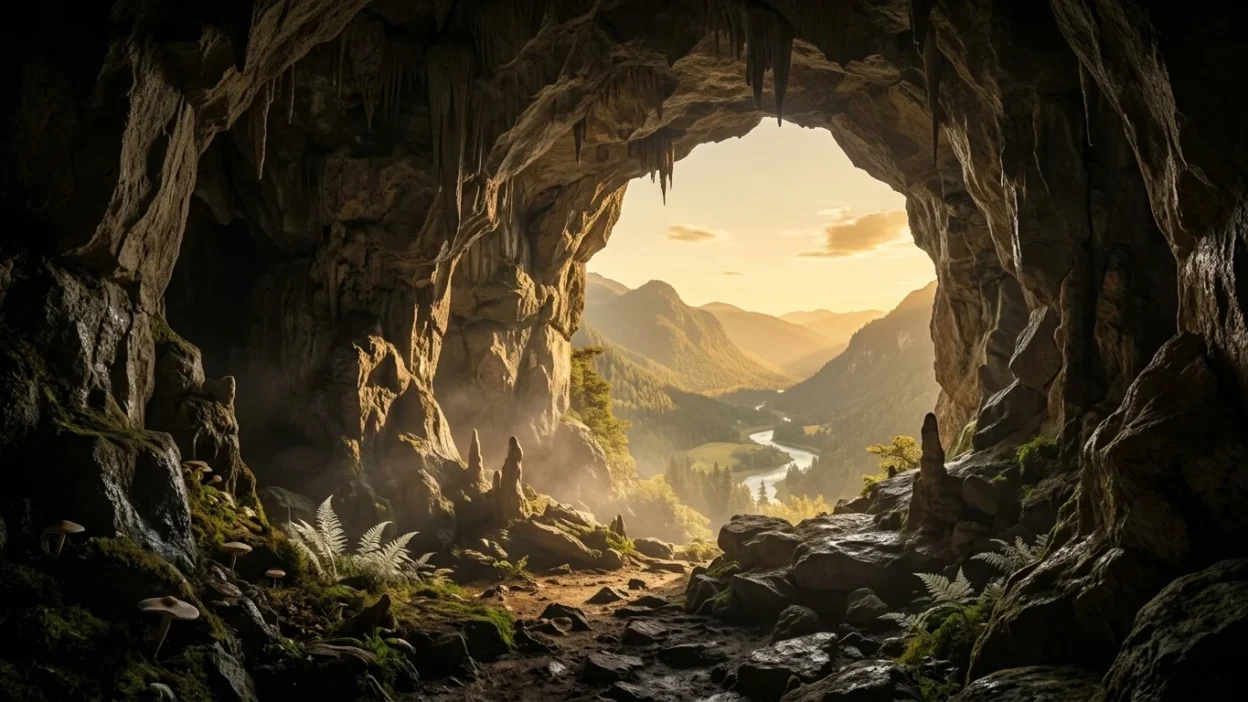
Cave symbolism often represents mystery, introspection, protection, transformation, solitude, and the hidden parts of human experience. A cave is dark, enclosed, ancient, and separate from the ordinary world. Because of these qualities, caves have carried powerful symbolic meanings across spirituality, religion, mythology, literature, art, dreams, and modern culture.
A cave can feel frightening because it hides what lies beyond the entrance. Yet it can also feel peaceful and protective. This contrast makes cave symbolism especially meaningful. Entering a cave may represent moving inward, facing something unknown, or discovering knowledge that was hidden from view.
Cave Symbolism Meaning (Clear Definition)
Cave symbolism refers to the symbolic meanings associated with caves, underground spaces, darkness, hidden chambers, and enclosed natural environments.
At its core, a cave can symbolize the unknown, inner reflection, protection, mystery, transformation, solitude, rebirth, and hidden knowledge.
A cave has a natural connection with the idea of going inward. Unlike an open landscape, it limits what can immediately be seen. This can represent the inner world of thoughts, emotions, memories, fears, and spiritual questions.
Common meanings of cave symbolism include:
| Cave Symbol | Symbolic Meaning |
|---|---|
| Cave entrance | Transition and opportunity |
| Darkness | Mystery and the unknown |
| Inner chamber | Hidden knowledge and introspection |
| Shelter | Safety and protection |
| Underground space | The subconscious and inner world |
| Cave journey | Personal transformation |
| Light inside a cave | Hope, understanding, and revelation |
| Emerging from a cave | Rebirth and renewal |
| Ancient cave | Memory, history, and ancestral wisdom |
The meaning of a cave depends greatly on its context. A peaceful cave may suggest refuge, while a frightening cave may represent fear or uncertainty.
What Does Cave Symbolism Represent?
Cave symbolism can represent several interconnected ideas. Its meaning often changes depending on whether the cave is being viewed as a place of shelter, darkness, discovery, or transformation.
Mystery and the Unknown
A cave hides much of itself from the outside world. Its tunnels may extend farther than expected, and darkness can make it impossible to see what lies ahead.
For this reason, caves often symbolize mystery and uncertainty. They can represent questions whose answers are not immediately available.
Introspection and the Inner Self
Entering a cave can be compared symbolically to turning inward.
A person may retreat from external distractions to think, heal, reflect, or understand their emotions. The cave therefore becomes a powerful image of introspection and self-discovery.
Protection and Shelter
Caves have historically provided natural shelter. Symbolically, this makes them associated with safety, privacy, rest, and protection.
A cave can represent the need to step away from external pressures and find a secure place for recovery.
Transformation and Rebirth
The movement into and out of a cave creates a natural symbolic journey. Going inside can represent leaving the familiar, while emerging can represent returning with new understanding.
This makes caves symbols of transformation, renewal, and rebirth.
Hidden Knowledge
Because caves contain concealed spaces, they can symbolize knowledge that must be discovered rather than simply given.
A cave journey may therefore represent learning about oneself, uncovering forgotten memories, or discovering a truth that was previously hidden.
Spiritual Meaning of Cave Symbolism
Spiritually, cave symbolism often represents inner reflection, spiritual retreat, transformation, silence, and deeper awareness.
A cave separates a person from the noise of the outside world. In symbolic terms, this can create a sacred space for contemplation.
Many spiritual traditions have used caves, mountains, wilderness areas, and secluded places as settings for retreat or religious experience. The physical act of moving away from ordinary surroundings can symbolize turning toward a deeper spiritual reality.
The darkness of a cave can also represent the unknown aspects of spiritual life. A person may not always understand where a spiritual journey will lead, but the uncertainty itself can become part of the experience.
A light appearing within darkness has an especially powerful symbolic meaning. It may represent hope, wisdom, faith, guidance, or a new understanding emerging after confusion.
Cave symbolism can therefore suggest that meaningful growth sometimes requires silence and inward attention.
Biblical / Religious Meaning of Cave Symbolism
Caves appear in several important biblical stories and religious traditions, although their meanings vary according to context.
In the Bible, caves can function as places of refuge, hiding, burial, isolation, and significant encounters. For example, David sought refuge in caves while fleeing danger. The cave therefore becomes associated with protection, vulnerability, and waiting during a difficult period.
The story of Elijah also includes a cave as a setting for retreat and divine encounter. In that context, the cave can be understood as a place of solitude and spiritual listening.
Caves are also associated with burial in biblical narratives. This creates another layer of symbolism involving death, remembrance, transition, and the boundary between one stage of existence and another.
Religious interpretations should therefore be understood in context rather than reduced to one universal meaning. A biblical cave may represent refuge in one passage and burial or transition in another.
Cave Symbolism in History and Culture
Caves have played important practical, cultural, and symbolic roles throughout human history.
Early humans used caves for shelter and habitation, and prehistoric cave paintings provide some of the oldest surviving examples of human artistic expression. These ancient images connect caves with memory, storytelling, ritual, creativity, and humanity’s early attempts to understand the world.
Because caves are naturally enclosed and protected from many environmental changes, they can also preserve traces of the past. Symbolically, this gives caves a connection with ancestry, memory, ancient knowledge, and hidden history.
Across different cultures, caves have also been associated with sacred places, mythical beings, spiritual journeys, and entrances to other worlds.
This recurring pattern is understandable. A cave is literally a threshold between the familiar surface world and a hidden environment below it. Such a dramatic transition naturally invites symbolic interpretations about life, death, mystery, and transformation.
Cave Symbolism in Literature and Art
Caves have been powerful images in literature and art because they allow creators to explore hidden dimensions of human experience.
One of the most famous philosophical examples is Plato’s Allegory of the Cave. In this story, people inside a cave mistake shadows for reality. The journey out of the cave represents movement from limited perception toward greater understanding.
This example helped establish the cave as a powerful symbol of perception, illusion, knowledge, and awakening.
In literature, a cave may serve as a place where a character confronts fear, discovers something valuable, hides from danger, or undergoes an important change.
Artists may use cave imagery to create feelings of mystery, isolation, vulnerability, or wonder. The contrast between darkness and light is particularly useful for expressing the movement from ignorance toward understanding.
A cave can also become a psychological landscape. Its tunnels may represent complicated thoughts, while its hidden chambers may suggest memories or emotions that have not yet been explored.
Dream Meaning of Cave Symbolism
Dreaming about a cave can symbolize introspection, uncertainty, emotional withdrawal, protection, transformation, or the discovery of something hidden within yourself.
The emotional atmosphere of the dream is especially important.
- Entering a cave: May symbolize beginning an inward journey or exploring an unfamiliar part of yourself.
- Being lost inside a cave: Can represent confusion, uncertainty, or feeling emotionally overwhelmed.
- Finding light inside a cave: May suggest hope, insight, guidance, or emerging understanding.
- Hiding in a cave: Can symbolize a desire for safety, privacy, or temporary withdrawal.
- A peaceful cave: May represent emotional rest, reflection, or a need for solitude.
- A frightening cave: Could reflect fears, unresolved emotions, or uncertainty about the future.
- Finding something inside a cave: May symbolize discovering hidden knowledge, memories, talents, or personal truths.
- Leaving a cave: Can represent renewal, personal growth, or moving beyond a difficult period.
Dream interpretation is personal rather than predictive. A cave dream does not automatically indicate that something will happen. Your feelings, experiences, and circumstances provide important context.
Modern Meaning of Cave Symbolism
Today, cave symbolism remains relevant because modern life can be crowded with information, communication, and constant external stimulation.
A cave can symbolize the need to disconnect and create space for reflection.
In this sense, retreating into a metaphorical cave does not necessarily mean isolation in a negative way. It may represent taking time to rest, think, recover, or reconnect with personal priorities.
Caves can also symbolize the subconscious mind. Psychology and popular culture often use underground spaces as metaphors for memories, fears, desires, and aspects of identity that remain outside everyday awareness.
At the same time, cave imagery continues to represent adventure and discovery. Modern exploration, nature photography, documentaries, and outdoor recreation often portray caves as places where people encounter geological beauty and hidden environments.
The cave therefore carries two seemingly opposite meanings: retreat from the world and exploration of the unknown.
Cave Symbolism in Love and Relationships
In relationships, cave symbolism can represent emotional intimacy, privacy, vulnerability, protection, and deeper connection.
A cave can symbolize a private emotional space where two people feel safe enough to reveal thoughts and feelings that they do not share with everyone.
Entering a cave together may represent moving beyond surface-level interaction toward greater emotional intimacy.
However, the cave can also have a shadow meaning. If someone feels trapped inside it, the image may reflect emotional isolation, secrecy, avoidance, or difficulty communicating.
The symbolic meaning depends on the experience. A warm and safe cave may represent trust, while a dark and confining cave may suggest emotional distance or fear.
The Shadow Side of Cave Symbolism
Cave symbolism is not always comforting.
Darkness, isolation, confinement, and uncertainty can make caves powerful symbols of fear and emotional struggle. A cave may represent avoidance when a person retreats from challenges rather than facing them.
It can also symbolize becoming too isolated. Solitude can be healing, but prolonged withdrawal may prevent connection, support, and growth.
Another shadow meaning is being trapped in the past. Because caves are associated with ancient spaces and hidden memories, they may symbolize experiences that remain buried but continue to influence the present.
The deeper lesson is balance. Going inward can provide wisdom, but eventually there may be a need to return to the outside world.
What Cave Symbolism Can Teach Us
Cave symbolism offers several meaningful lessons about personal growth.
Solitude can create clarity.
Stepping away from noise and distractions can make it easier to understand what truly matters.
The unknown does not always mean danger.
Darkness can represent uncertainty, but it can also be the beginning of discovery.
Growth often requires going inward.
Understanding external circumstances becomes easier when we also examine our thoughts, emotions, and motivations.
Protection has value.
A period of rest or retreat can provide the strength needed to face future challenges.
Hidden things deserve attention.
Unexplored emotions, memories, and talents can influence our lives even when we do not consciously recognize them.
Transformation requires movement.
The symbolic journey into a cave becomes meaningful when it eventually leads to greater awareness and a return to the world with new understanding.
Frequently Asked Questions About Cave Symbolism
What is the main meaning of cave symbolism?
Cave symbolism commonly represents mystery, introspection, protection, transformation, solitude, hidden knowledge, and the unknown.
What does a cave symbolize spiritually?
Spiritually, a cave can represent retreat, contemplation, inner exploration, spiritual transformation, and the search for deeper wisdom.
What does dreaming about a cave mean?
A cave dream may symbolize uncertainty, emotional reflection, protection, hidden feelings, or personal transformation. The details and emotions within the dream influence its meaning.
What does a cave symbolize in love?
A cave can symbolize intimacy, emotional safety, privacy, vulnerability, and deeper connection. It can also represent isolation or secrecy when the cave feels dark or confining.
Is cave symbolism positive or negative?
Cave symbolism can have both positive and negative meanings. It may represent healing, protection, discovery, and transformation, while also reflecting fear, isolation, uncertainty, or avoidance.
Conclusion
Cave symbolism reminds us that darkness is not always something to fear. A cave can represent the hidden places where reflection, healing, knowledge, and transformation begin. Its deepest lesson is that sometimes we must journey inward before we can emerge with greater clarity, strength, and understanding.

Miles Maverick is a content writer and symbolism enthusiast at BibloSign.com, specializing in symbol meanings, cultural interpretations, and historical symbolism, helping readers discover deeper insights behind signs, icons, and symbolic traditions.