Desert symbolism is often associated with solitude, endurance, spiritual testing, transformation, freedom, resilience, and inner discovery. A desert can appear empty and harsh, yet it is also a place of remarkable survival, beauty, silence, and hidden life.
Because deserts receive little rainfall and can have extreme conditions, they naturally symbolize the challenges people face when familiar sources of comfort disappear. At the same time, the desert can represent clarity, independence, and the opportunity to discover what truly matters.
Understanding desert symbolism can reveal meaningful connections between nature, spirituality, dreams, literature, culture, and personal growth.
Desert Symbolism Meaning (Clear Definition)
Desert symbolism refers to the meanings and ideas people associate with desert landscapes based on their physical characteristics, cultural traditions, spiritual experiences, and personal interpretations.
The desert commonly symbolizes endurance and survival. Life exists there despite limited water, intense heat, scarce vegetation, and challenging conditions. This makes the desert a powerful image of resilience.
The desert can also represent solitude. Its wide, open spaces and sparse population create an environment where a person may be separated from ordinary distractions.
Common meanings of desert symbolism include:
- Endurance – surviving difficult circumstances.
- Solitude – spending time away from noise and distractions.
- Spiritual testing – facing challenges that encourage deeper reflection.
- Transformation – changing through hardship and uncertainty.
- Freedom – experiencing openness and independence.
- Clarity – removing distractions and focusing on essentials.
- Resilience – continuing despite limited resources.
- Renewal – discovering life or hope where it seems least expected.
A desert is therefore not simply a symbol of emptiness. It can represent a landscape where unnecessary things fall away and essential qualities become easier to recognize.
What Does Desert Symbolism Represent?
Desert symbolism represents the experience of moving through difficulty, uncertainty, solitude, and transformation while discovering inner strength.
One of its strongest meanings is endurance. A desert may look lifeless from a distance, yet many plants and animals have developed remarkable ways to survive there.
This creates a powerful metaphor for people. Someone may appear to be going through a barren or difficult period while quietly developing strength and resilience.
The desert also represents solitude. Being surrounded by open land and silence can symbolize stepping away from social expectations and listening more closely to your own thoughts.
Another important meaning is simplicity. Deserts contain relatively few visible elements compared with forests or crowded cities. Symbolically, this can represent stripping life down to what is essential.
| Desert Symbolism | Common Meaning |
|---|---|
| Endurance | Surviving difficult conditions |
| Solitude | Reflection and independence |
| Resilience | Adapting to hardship |
| Spiritual testing | Inner examination and growth |
| Freedom | Openness and independence |
| Clarity | Focus and simplicity |
| Transformation | Change through adversity |
| Hope | Life appearing in unexpected places |
The desert can therefore represent both difficulty and possibility. Its harshness challenges life, while its hidden ecosystems demonstrate that survival can take forms we do not immediately notice.
Spiritual Meaning of Desert Symbolism
Spiritually, the desert is often associated with solitude, purification, spiritual testing, contemplation, surrender, and transformation.
A desert removes many of the distractions found in ordinary life. Without constant entertainment or social stimulation, a person may become more aware of their thoughts, fears, values, and beliefs.
This is why desert landscapes often appear in spiritual stories. The physical isolation can represent an inner journey.
The desert can symbolize a period when familiar sources of comfort seem unavailable. Such a period may feel empty, but it can also create space for reflection and a deeper understanding of oneself.
Spiritually, desert symbolism may encourage you to:
- Spend time in quiet reflection.
- Identify what is truly essential.
- Develop patience during uncertain periods.
- Trust your ability to endure difficulty.
- Release distractions that no longer serve you.
- Look for small signs of hope and renewal.
- Allow difficult experiences to reshape your perspective.
The desert’s silence can also symbolize listening. When external noise becomes quieter, internal questions may become more noticeable.
For this reason, the desert is often less a symbol of emptiness than a symbol of inner space.
Biblical / Religious Meaning of Desert Symbolism
The desert has a particularly important place in biblical and religious symbolism. It can represent testing, wandering, dependence, purification, preparation, isolation, and encounters with the divine.
In the Hebrew Bible, the Israelites’ journey through the wilderness is one of the most important examples. The wilderness becomes a place of uncertainty and hardship, but also a place where the people experience guidance, provision, and a developing relationship with God.
The desert is also important in the Christian New Testament. Jesus spends forty days in the wilderness, where the experience is associated with fasting, temptation, and spiritual preparation.
These traditions contribute to the idea that a desert can represent a difficult period that also carries spiritual significance.
However, religious desert symbolism is not limited to suffering. The wilderness can also be a place where people encounter God, receive guidance, and develop dependence on something greater than themselves.
In religious interpretation, the desert can therefore symbolize a testing ground and a place of transformation.
Desert Symbolism in History and Culture
Deserts have shaped human civilizations, migration routes, trade networks, architecture, clothing, agriculture, and storytelling for thousands of years.
Although deserts can be extremely challenging environments, people have developed sophisticated ways of living within them. Knowledge of water sources, seasonal conditions, plants, animals, navigation, and shelter has allowed communities to thrive in regions that outsiders might consider uninhabitable.
This reality adds an important dimension to desert symbolism: adaptation.
Deserts have also been associated with trade and exploration. Historic routes across arid regions connected distant communities and allowed goods, languages, technologies, and ideas to travel between cultures.
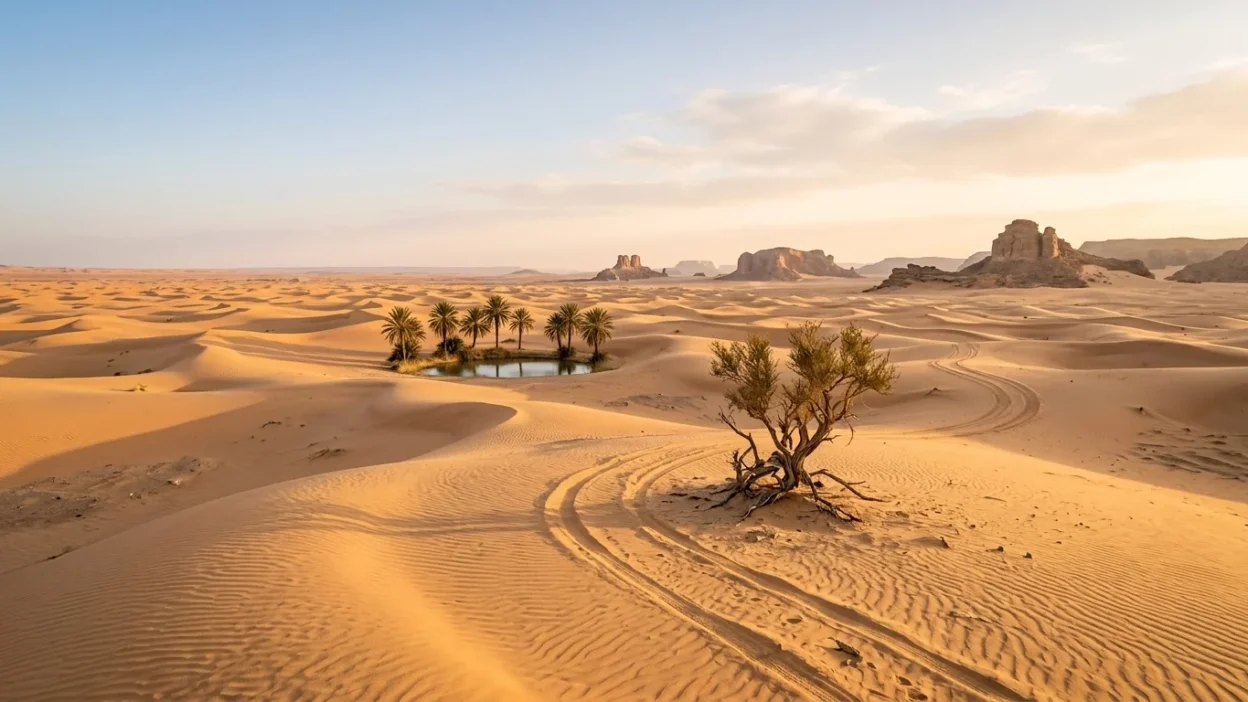
Oases became especially powerful symbols because they offered water and life within seemingly barren surroundings. As a result, an oasis can represent hope, relief, abundance, and unexpected opportunity.
Culturally, desert landscapes may also symbolize freedom because of their enormous open spaces. At the same time, their vastness can create feelings of isolation and vulnerability.
These contrasting meanings make desert symbolism particularly rich.
Desert Symbolism in Literature and Art
Deserts have inspired writers, poets, painters, photographers, filmmakers, and other artists because they provide a striking setting for stories about isolation and transformation.
In literature, a character traveling through a desert may be physically searching for water while symbolically searching for meaning, identity, direction, or hope.
The emptiness of the landscape can also mirror emotional experiences. A character who feels lonely or disconnected may be placed in a barren environment to reinforce that emotional state.
Yet deserts are not always portrayed negatively. Their silence, enormous skies, changing colors, and dramatic horizons can represent freedom, beauty, mystery, and spiritual discovery.
Artists often use the contrast between empty sand and small signs of life to communicate hope. A single plant, animal, oasis, or distant light can become visually powerful because of the surrounding emptiness.
The desert therefore functions as both a physical landscape and a metaphor for the inner world.
Dream Meaning of Desert Symbolism
Dreaming about a desert can have different meanings depending on the landscape, your emotions, and what happens during the dream.
A vast empty desert may represent loneliness, uncertainty, emotional distance, or a desire for solitude.
Walking through a desert can symbolize perseverance during a difficult period or searching for direction.
Finding an oasis may represent hope, emotional relief, unexpected support, or the discovery of a new opportunity.
Being lost in a desert can reflect confusion, uncertainty, or feeling disconnected from your goals.
Finding water may symbolize emotional renewal, relief, nourishment, or the return of hope.
A peaceful desert landscape can represent freedom, clarity, independence, or a desire to escape everyday distractions.
Dream symbolism is personal rather than predictive. Your feelings during the dream can provide important clues about whether the desert represents challenge, freedom, solitude, or transformation in your life.
Modern Meaning of Desert Symbolism
Today, desert symbolism often represents minimalism, independence, resilience, self-discovery, and the search for meaning.
Modern life can be crowded with information, responsibilities, technology, and constant communication. The desert’s silence offers a powerful contrast to this environment.
For some people, the desert represents the desire to simplify life and remove unnecessary distractions.
The desert can also symbolize resilience in the face of uncertainty. Its ability to support life under difficult conditions reminds us that adaptation is often more important than perfect circumstances.
Desert Symbolism in Love and Relationships
In relationships, desert symbolism can represent loneliness, emotional distance, endurance, and the search for connection.
A dry or empty desert may symbolize a relationship that feels emotionally disconnected or lacking nourishment.
An oasis, by contrast, can represent love as a source of comfort and renewal during difficult circumstances.
The symbolism can also describe relationships that survive challenging periods. Like life in a desert, a strong relationship may require patience, adaptation, and careful attention to limited emotional resources.
Healthy relationships, however, should provide nourishment rather than asking one person to survive emotional deprivation indefinitely.
The Shadow Side of Desert Symbolism
Desert symbolism has a challenging side that should not be ignored.
It can represent loneliness, emotional emptiness, isolation, deprivation, uncertainty, and feeling lost.
Solitude can encourage reflection, but too much isolation can become harmful. Similarly, endurance can be valuable, but constantly enduring difficult conditions without seeking support may lead to exhaustion.
The desert therefore teaches an important lesson about balance. Resilience does not mean refusing help, and independence does not mean living without connection.
What Desert Symbolism Can Teach Us
Desert symbolism offers several lessons that can apply to everyday life.
You can survive difficult seasons. The desert demonstrates that life can adapt even under severe conditions.
Simplicity can create clarity. Removing unnecessary distractions can make important priorities easier to recognize.
Solitude can be useful. Time alone can provide space for reflection and self-understanding.
Small signs of life matter. A single plant or oasis becomes meaningful because of its surroundings. Small sources of hope can matter greatly during difficult periods.
Adaptation is strength. Desert life survives not by eliminating hardship but by responding intelligently to it.
Hard seasons can change you. Difficult experiences may reveal strengths and values that remain hidden during easier periods.
Hope can appear unexpectedly. An oasis reminds us that relief and renewal can exist even when circumstances initially seem barren.
Frequently Asked Questions About Desert Symbolism
What is the main meaning of desert symbolism?
Desert symbolism commonly represents endurance, solitude, resilience, spiritual testing, transformation, freedom, clarity, and hope. Its meaning depends on the cultural and personal context.
What does a desert symbolize spiritually?
Spiritually, a desert can represent testing, purification, solitude, contemplation, spiritual preparation, and transformation. It may symbolize a period of seeking deeper understanding.
What does a desert mean in dreams?
A desert in a dream may represent loneliness, uncertainty, perseverance, independence, or a search for direction. An oasis or source of water can introduce themes of hope and renewal.
What does an oasis symbolize in the desert?
An oasis commonly symbolizes hope, relief, nourishment, opportunity, renewal, and unexpected support. Its life-giving presence contrasts with the harshness of the surrounding desert.
What does a desert symbolize in love?
In relationships, a desert can symbolize emotional distance, loneliness, or a difficult period. Finding water or an oasis may symbolize renewed connection, comfort, and emotional nourishment.
Conclusion
Desert symbolism captures the powerful relationship between hardship and transformation. A desert may represent loneliness or testing, but it can also symbolize freedom, resilience, clarity, spiritual discovery, and hidden life.
Its deepest lesson may be that emptiness is not always the absence of meaning. Sometimes silence creates the space needed to discover what truly matters.

Gabriel Santiago is a dedicated writer and symbolism researcher at BibloSign.com, passionate about exploring symbol meanings, cultural traditions, spiritual interpretations, and historical significance to help readers better understand the world of symbolism.