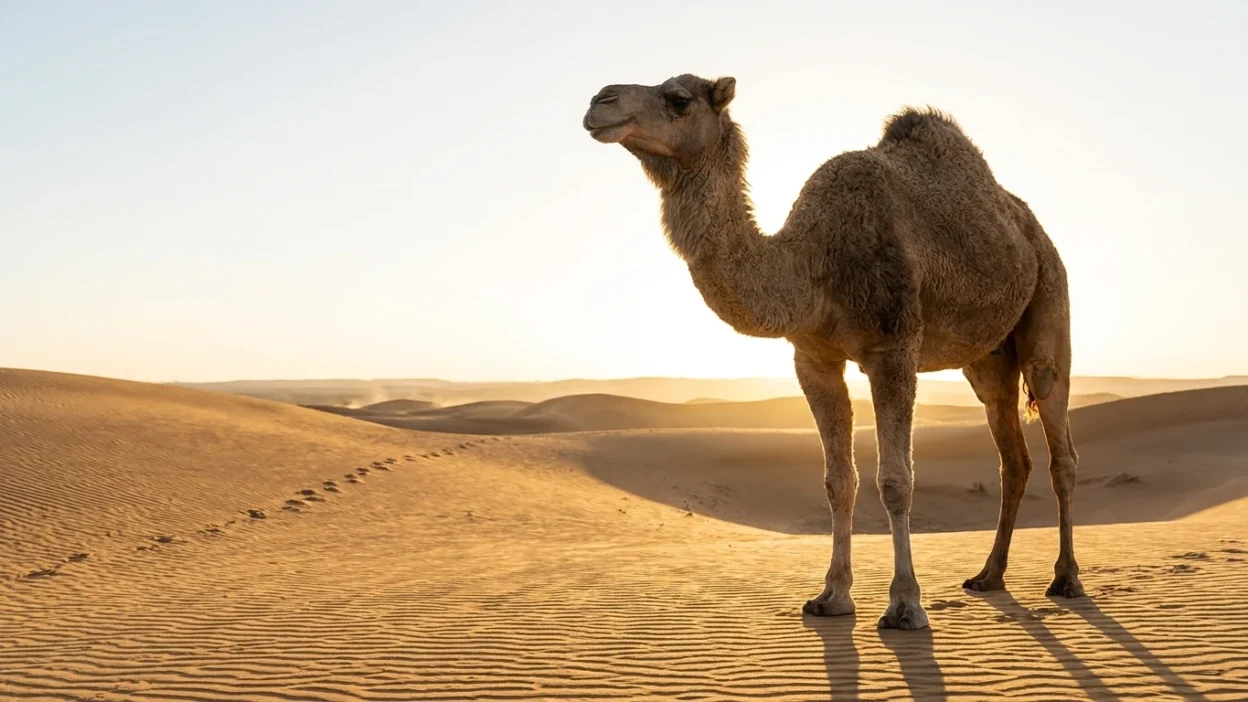
Camel symbolism is deeply connected with endurance, patience, resilience, survival, wisdom, and the ability to keep moving through difficult circumstances. Known for crossing vast deserts while enduring heat, scarcity, and long journeys, the camel has become a powerful symbol of strength through patience rather than force.
The camel’s ability to conserve energy and survive in harsh environments gives it a unique symbolic message: sometimes, true strength means knowing how to endure, adapt, and continue when the path ahead is demanding.
For many people, camel symbolism represents a journey through hardship toward greater wisdom, stability, and purpose.
Camel Symbolism Meaning (Clear Definition)
Camel symbolism refers to the meanings traditionally associated with the camel’s endurance, adaptability, patience, strength, and role as a dependable traveler.
In simple terms, camel symbolism represents endurance, resilience, patience, resourcefulness, and the ability to survive difficult journeys.
The camel is often viewed as a symbol of someone who can carry heavy responsibilities without giving up. Its association with deserts also connects it with self-sufficiency and survival when resources are limited.
Key Camel Symbolism Meanings
| Symbolic Meaning | What It Represents |
|---|---|
| Endurance | Continuing despite hardship or exhaustion |
| Patience | Allowing progress to unfold in its own time |
| Resilience | Recovering and remaining strong through adversity |
| Wisdom | Understanding how to conserve energy and choose the right path |
| Adaptability | Adjusting to difficult environments and circumstances |
| Strength | Carrying responsibilities without easily giving up |
| Journey | Moving steadily toward a distant goal |
The camel is therefore less about sudden success and more about steady progress, preparation, and lasting strength.
What Does Camel Symbolism Represent?
Camel symbolism represents qualities that become especially important when life feels demanding or uncertain.
Endurance and Resilience
Perhaps the strongest meaning associated with the camel is endurance.
Camels are adapted to environments where extreme temperatures, limited water, and scarce food can make survival difficult. Symbolically, this makes the camel a reminder that difficult conditions do not automatically mean the journey must end.
Camel symbolism can encourage you to keep going when progress feels slow. Sometimes resilience is not about moving quickly; it is about refusing to stop.
Patience and Persistence
A camel crossing a desert is a powerful image of patient progress. There may be no immediate reward, yet the animal continues toward its destination.
This makes the camel a symbol of patience and persistence. It encourages a long-term mindset instead of expecting every goal to be achieved quickly.
If you are working toward something meaningful, camel symbolism suggests that consistency may matter more than speed.
Strength and Responsibility
Camels have historically been valued as working and transport animals because they can carry people and goods across challenging terrain.
As a symbol, this represents the ability to carry responsibilities with determination.
The message is not that you should carry every burden alone. Instead, it can remind you to recognize your capacity while also learning when a load has become too heavy.
Resourcefulness and Self-Sufficiency
Camel symbolism is also associated with resourcefulness. The animal’s adaptations allow it to function in environments where many other animals would struggle.
Symbolically, this can represent the ability to make wise use of limited resources.
It may encourage you to ask yourself:
- What resources do I already have?
- Where am I wasting energy?
- What should I preserve for the journey ahead?
- Which challenges require patience rather than immediate action?
Travel and Life’s Journey
The camel is strongly associated with long-distance travel, especially across deserts.
Because of this, it can symbolize a life journey filled with stages, challenges, pauses, and destinations.
The camel teaches a valuable lesson about long journeys: you do not need to see the entire road before taking the next step.
Spiritual Meaning of Camel Symbolism
The spiritual meaning of camel symbolism is often associated with patience, endurance, faith, humility, resilience, and trust in the journey.
Spiritually, the desert can represent a period when life feels empty, uncertain, or difficult. The camel moving through that environment becomes a metaphor for maintaining strength when external circumstances offer little comfort.
The camel may therefore appear symbolically during times when you are being asked to develop inner endurance.
Its message can be especially meaningful when progress seems invisible. Just because the destination is still far away does not mean you are not moving forward.
Camel as a Hero
For people who work with animal symbolism, the camel can represent:
- Patience during long challenges
- Strength without unnecessary aggression
- Resilience after setbacks
- Wise use of time and energy
- Adaptability in changing circumstances
- Confidence during difficult journeys
- Faith in reaching a distant destination
A camel hero is often interpreted as a reminder to conserve your energy and focus it on what truly matters.
Instead of rushing toward every opportunity, camel symbolism encourages deliberate movement.
Biblical / Religious Meaning of Camel Symbolism
Camels have a significant presence in the Bible and other religious traditions, particularly in stories connected with travel, trade, wealth, hospitality, and journeys.
In the Bible, camels appear in several important narratives. They were valuable animals in the ancient Near East and were associated with long-distance transportation and the movement of goods.
One well-known biblical passage involving camels appears in the story of Abraham’s servant traveling to find a wife for Isaac. Camels are also associated with the wealth and possessions of important biblical figures.
Jesus famously referred to a camel in the teaching about the difficulty of a rich person entering the kingdom of God. The imagery emphasizes the spiritual danger of attachment to wealth rather than suggesting that camels themselves are negative symbols.
Because of these references, camel symbolism in a religious context can involve journey, provision, wealth, humility, service, and the difference between material possessions and spiritual priorities.
In Islamic culture, camels also have deep historical and religious significance. They played an important role in transportation, trade, desert life, and the development of communities across the Arabian Peninsula.
Religious interpretations vary, so camel symbolism should be understood within the specific tradition and context in which the animal appears.
Camel Symbolism in History and Culture
Few animals have been as important to desert civilizations as the camel.
For thousands of years, camels have helped people travel across arid regions, transport goods, support trade networks, and connect distant communities.
The camel’s importance became especially clear along ancient trade routes crossing parts of North Africa, the Middle East, and Central Asia.
Because of this historical role, camel symbolism extends beyond endurance. It can also represent commerce, connection, transportation, hospitality, survival, and cultural exchange.
In many desert societies, the camel was not merely an animal. It was a practical partner in daily life and long-distance travel.
Camels became associated with caravans carrying valuable goods across difficult landscapes. This gave the animal symbolic connections to prosperity and economic opportunity.
At the same time, the camel’s dependence on careful preparation made it a symbol of practical wisdom. Successful travelers had to understand their environment, manage supplies, and respect the demands of the journey.
Camel Symbolism Across Cultural Themes
The camel commonly appears as a symbol of:
- Desert survival
- Long-distance travel
- Trade and prosperity
- Patience and endurance
- Hospitality and service
- Adaptability
- Strength through difficult conditions
Its cultural meaning is therefore closely connected with the relationship between humans, nature, travel, and survival.
Camel Symbolism in Literature and Art
Camels have appeared in literature, paintings, poetry, folklore, photography, film, and other forms of art for centuries.
In literature, the camel often represents a difficult journey. A character traveling through a desert may be physically moving across the landscape while also undergoing an emotional or spiritual transformation.
The camel can become a companion figure that represents persistence during uncertainty.
Artists have also used camels to create powerful images of desert life. A camel caravan moving across an enormous landscape can symbolize isolation, adventure, exploration, patience, or the passage of time.
In poetry, the camel may represent endurance and quiet strength. Unlike symbols associated with dramatic power, such as lions or eagles, the camel often communicates a more grounded form of strength.
It is the strength to continue.
That distinction makes camel imagery particularly meaningful in stories about perseverance, exile, pilgrimage, exploration, and personal transformation.
Dream Meaning of Camel Symbolism
Dreaming about a camel may symbolize endurance, responsibility, patience, travel, resilience, or a long-term challenge.
The details of the dream matter greatly. A peaceful camel can suggest confidence and stability, while an overloaded or distressed camel may reflect emotional exhaustion or excessive responsibilities.
Here are some common camel dream interpretations:
- Seeing a camel: You may be preparing for a demanding journey or important period of growth.
- Riding a camel: This can represent progress, direction, or relying on patience to reach a goal.
- A camel caravan: It may symbolize community, teamwork, travel, or shared responsibilities.
- A camel carrying a heavy load: This can reflect burdens, obligations, or emotional pressure.
- A calm camel: It may represent inner strength, patience, and stability.
- A thirsty camel: This could symbolize depleted energy, emotional needs, or a need to rest.
- A camel crossing a desert: It may represent perseverance through a difficult stage of life.
- An aggressive camel: This might reflect frustration, resistance, or a situation that feels difficult to control.
Dream symbolism is personal rather than universal. Your emotions during the dream and the circumstances of your waking life can provide the most meaningful clues.
Modern Meaning of Camel Symbolism
In modern life, camel symbolism remains relevant because people continue to face long-term challenges that require patience rather than instant solutions.
The camel can symbolize resilience in stressful times, sustainable effort, emotional endurance, and thoughtful progress.
Its message is especially useful in a culture that often celebrates speed.
Not every meaningful goal can be achieved quickly. Some ambitions require years of learning, repeated effort, setbacks, and adjustment.
Camel symbolism encourages a different approach: protect your energy, prepare carefully, remain flexible, and continue moving toward what matters.
The camel can also represent healthy boundaries. Endurance does not mean accepting unlimited burdens.
True resilience includes knowing when to rest, when to change direction, and when to ask for support.
In this sense, the camel is not simply a symbol of surviving hardship. It is a symbol of surviving wisely.
Frequently Asked Questions About Camel Symbolism
What is the main meaning of camel symbolism?
The main meaning of camel symbolism is endurance, patience, resilience, adaptability, and the ability to continue through difficult circumstances.
What does a camel symbolize spiritually?
Spiritually, a camel can symbolize patience, faith, inner strength, humility, and trust during a long or challenging life journey.
Is seeing a camel a good sign?
Symbolically, seeing a camel can be a positive reminder to remain patient, conserve your energy, and trust steady progress during challenging periods.
What does a camel mean in a dream?
A camel in a dream may represent responsibility, endurance, travel, resilience, or a long-term challenge. The specific meaning depends on the dream’s details and your emotional response.
What does a camel symbolize in the Bible?
In the Bible, camels appear in stories involving travel, wealth, transportation, and important journeys. They also feature in Jesus’ teaching about wealth and spiritual priorities.
Conclusion
Camel symbolism teaches one of life’s most valuable lessons: you do not have to move quickly to move forward.
Through its association with endurance, patience, resilience, wisdom, and long journeys, the camel reminds us that difficult seasons can be survived through preparation, adaptability, and steady effort.
When the road ahead feels long, camel symbolism offers a quiet message of encouragement: protect your energy, carry what truly matters, and keep moving toward your destination.

Gabriel Santiago is a dedicated writer and symbolism researcher at BibloSign.com, passionate about exploring symbol meanings, cultural traditions, spiritual interpretations, and historical significance to help readers better understand the world of symbolism.