
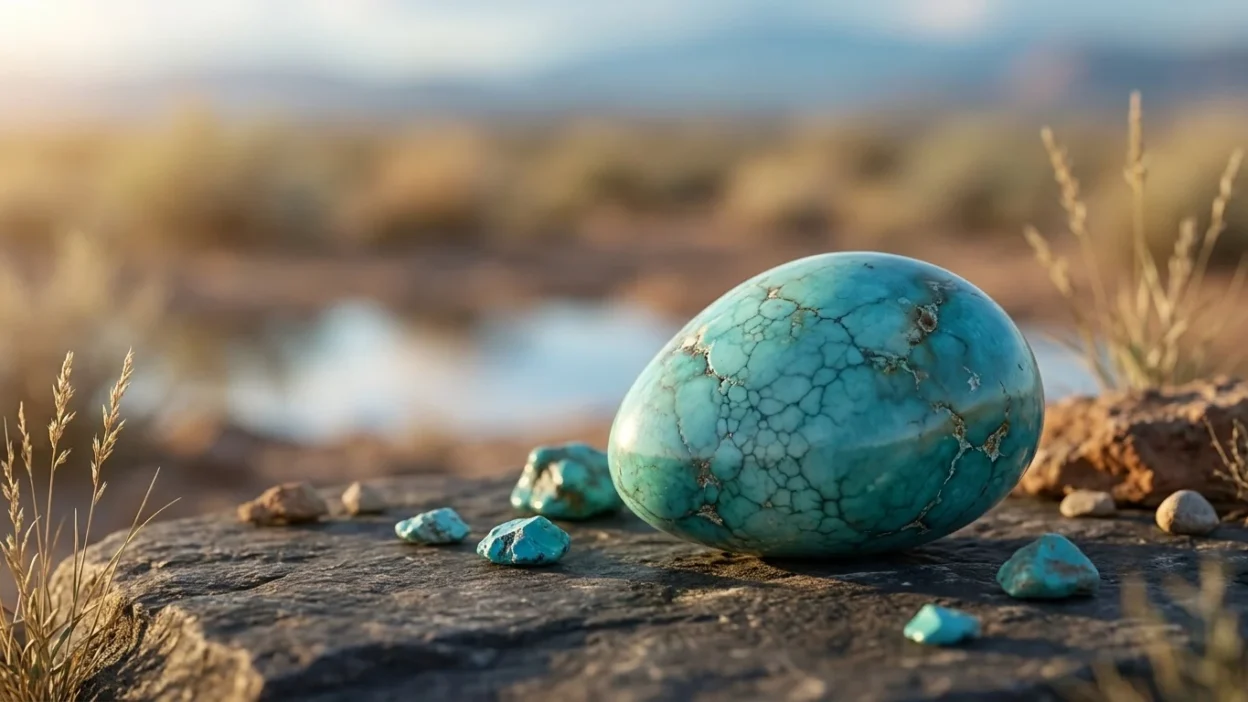
Turquoise symbolism is closely associated with protection, healing, wisdom, peace, communication, and spiritual connection. Its distinctive blue-green color has made it one of the most recognizable and culturally significant gemstones in human history.
For thousands of years, turquoise has been valued not only for its beauty but also for the meanings people have attached to it. Ancient communities used it in jewelry, ceremonial objects, protective pieces, and decorative art.
Today, turquoise continues to symbolize calmness, emotional balance, personal expression, and connection with nature. Its unusual color brings together the qualities of blue skies and green earth, creating a powerful image of harmony and renewal.
Turquoise Symbolism Meaning (Clear Definition)
Turquoise symbolism represents protection, peace, healing, wisdom, communication, emotional balance, good fortune, and spiritual awareness.
It is an opaque mineral that commonly appears in shades ranging from blue to blue-green and green. Its color can vary depending on its mineral composition and geological formation.
Symbolically, this distinctive color has helped turquoise become associated with both the sky and water. Blue can suggest calmness and openness, while green can evoke nature, growth, and renewal.
At its heart, turquoise symbolism represents a peaceful connection between inner wellbeing and the world around us.
It can also symbolize the courage to communicate honestly. Because turquoise has long been worn as jewelry, it is often interpreted as a personal protective symbol carried close to the body.
What Does Turquoise Symbolism Represent?
Turquoise has accumulated many symbolic meanings across different cultures and periods.
| Symbolic Meaning | What It Represents |
|---|---|
| Protection | Safety, guardianship, and spiritual security |
| Peace | Calmness, harmony, and emotional serenity |
| Healing | Renewal, recovery, and emotional restoration |
| Wisdom | Experience, awareness, and thoughtful judgment |
| Communication | Honest expression and meaningful connection |
| Good Fortune | Blessings, prosperity, and positive possibilities |
| Spirituality | Reflection, intuition, and connection with the sacred |
| Renewal | Growth, fresh beginnings, and emotional change |
One of the strongest associations is protection. Turquoise has traditionally been worn or carried as a protective stone in various cultures.
Its association with peace comes naturally from its blue-green color. The stone can evoke clear skies, tranquil water, and natural landscapes.
Turquoise is also connected with communication. Its symbolism can encourage people to express feelings clearly while listening carefully to others.
Other common meanings include:
- Protection and safety
- Peace and calm
- Emotional healing
- Wisdom and awareness
- Honest communication
- Spiritual connection
- Good fortune
- Renewal and growth
These meanings come from cultural traditions and personal symbolism rather than scientifically established properties of the stone.
Spiritual Meaning of Turquoise Symbolism
Spiritually, turquoise symbolism is often associated with protection, inner peace, communication, intuition, and connection with nature.
Its color creates an interesting symbolic balance. Blue can represent openness and calm, while green can represent life and renewal. Together, these qualities can suggest emotional and spiritual harmony.
For someone using turquoise as a personal spiritual symbol, the stone may represent a desire to become more peaceful, honest, and aware.
Turquoise can symbolically encourage:
- Speaking with honesty and compassion
- Listening to inner feelings
- Remaining calm during difficult experiences
- Creating healthier emotional boundaries
- Connecting more deeply with nature
- Beginning a period of personal renewal
- Trusting thoughtful intuition
Turquoise is also sometimes associated with journeys. Historically, travelers have carried turquoise objects as protective symbols, giving the stone a spiritual connection with movement, uncertainty, and safe passage.
Its deeper spiritual lesson can therefore be understood as moving through life with courage while remaining grounded and protected.
Biblical / Religious Meaning of Turquoise Symbolism
Turquoise does not have a clearly established, universally accepted symbolic meaning in the Bible. Some modern interpretations connect turquoise-like blue or green stones with themes such as heaven, protection, beauty, or divine creation, but these associations should not be presented as direct biblical teachings.
The Bible does mention various precious and semiprecious stones, especially in descriptions of priestly objects and sacred imagery. However, identifying every historical gemstone mentioned in ancient texts with modern mineral names can be uncertain.
Turquoise has stronger documented symbolic traditions in several cultures outside the biblical tradition.
In Islamic art and cultures, turquoise has often been appreciated for its beauty and has appeared in architecture, jewelry, ceramics, and decorative objects. In other traditions, it has been associated with protection, blessings, and spiritual significance.
The important distinction is between documented religious use and later symbolic interpretation. Turquoise can carry spiritual meaning for individuals without requiring that meaning to come directly from scripture.
Turquoise Symbolism in History and Culture
It has one of the longest histories of gemstone use. Ancient turquoise artifacts have been discovered in regions including the Middle East, Central Asia, and the Americas.
Ancient Egyptians valued turquoise and used it in jewelry, ornaments, and ceremonial objects. The stone was connected with beauty, status, and sacred symbolism.
In Persia, turquoise became especially important and was used extensively in architecture, decorative arts, and jewelry. Its blue-green color became strongly associated with beauty and protection.
Turquoise also holds deep significance among many Indigenous peoples of the American Southwest. Different nations have developed distinct traditions surrounding turquoise, including its use in jewelry, ceremonial contexts, art, and cultural expression. These traditions should not be treated as one single belief system because individual nations have their own histories and practices.
The stone’s relationship with the sky and natural landscape has contributed to its symbolism of protection, life, and connection with the natural world.
Throughout history, turquoise has therefore carried meanings involving beauty, protection, status, spirituality, nature, and cultural identity.
Turquoise Symbolism in Literature and Art
Turquoise has a strong visual presence in literature, painting, architecture, jewelry, and decorative art.
Its blue-green color can evoke open skies, clear water, desert landscapes, and distant horizons. Because of this, artists often use turquoise tones to create feelings of freedom, serenity, mystery, and natural beauty.
In literature, turquoise may function as a symbolic object representing a journey, treasured memory, protection, or emotional transformation.
Jewelry designers have also used turquoise to create pieces that feel both earthy and luminous. Its natural matrix patterns and variations make every stone visually distinctive.
The stone’s imperfections can add to its artistic appeal. Instead of being valued only for uniformity, natural turquoise is often appreciated for its unique veins, textures, and color variations.
This gives turquoise another symbolic meaning: beauty does not require perfection.
Dream Meaning of Turquoise Symbolism
Dreaming about turquoise can be interpreted as a symbolic reflection of your emotions, relationships, and current experiences. Dreams are personal and should not be treated as predictions.
Seeing bright turquoise in a dream may represent peace, emotional clarity, hope, or a desire for protection.
Finding turquoise could symbolize discovering a valuable insight or recognizing a personal strength that had previously been overlooked.
Receiving turquoise from someone may suggest trust, affection, support, or a meaningful emotional connection. Wearing turquoise could symbolize a desire to feel protected or confident while facing an uncertain situation.
Common symbolic interpretations include:
- Bright turquoise: hope, clarity, peace, or emotional renewal
- Wearing turquoise: protection, confidence, or self-expression
- Finding turquoise: discovering wisdom or hidden personal value
- Receiving turquoise: support, trust, or affection
- Losing turquoise: concerns about security or emotional stability
- Broken turquoise: change, disappointment, or the need for healing
- Turquoise water: emotional openness, freedom, or renewal
The most useful interpretation depends on the emotions you experienced during the dream and the personal meaning turquoise has for you.
Modern Meaning of Turquoise Symbolism
Today, turquoise remains popular in jewelry, fashion, interior design, art, and personal collections.
Modern turquoise symbolism often focuses on protection, self-expression, emotional balance, healing, individuality, and connection with nature.
Its distinctive color makes it particularly appealing to people who want something that feels natural yet expressive. Unlike gemstones associated primarily with luxury, turquoise often has a more earthy and personal character.
Turquoise can also represent authenticity. Natural stones vary in color, texture, and matrix patterns, meaning that no two pieces look exactly alike.
This makes the stone a fitting symbol for individuality and personal identity.
Turquoise Symbolism in Love and Relationships
Turquoise can symbolize honest communication, emotional support, trust, and lasting connection in relationships.
Its symbolism is less about dramatic passion and more about creating a relationship where people feel safe enough to speak honestly and listen with compassion.
As a gift, turquoise may therefore represent protection, friendship, affection, or a wish for peace and wellbeing.
The Shadow Side of Turquoise Symbolism
Turquoise symbolism can also have a less comfortable side.
A strong desire for peace can sometimes become avoidance. Someone may try so hard to prevent conflict that important feelings remain unspoken.
Likewise, the symbolism of protection can become excessive if safety turns into fear of change or emotional isolation.
The healthier lesson is balance: protect yourself without closing yourself off, seek peace without avoiding necessary conversations, and express yourself without losing compassion for others.
What Turquoise Symbolism Can Teach Us
Turquoise offers a meaningful reminder that peace and honest expression can exist together.
Its blue-green color brings together two natural images: the openness of the sky and the life-giving quality of the earth. Symbolically, this suggests staying grounded while remaining open to new possibilities.
Turquoise also teaches the value of authenticity. Natural variations in color and texture are part of what makes each stone beautiful.
In the same way, personal differences do not need to be hidden to create a meaningful life. Individuality can become part of your strength.
Frequently Asked Questions About Turquoise Symbolism
What is the main meaning of turquoise symbolism?
The main meanings of turquoise symbolism include protection, peace, healing, wisdom, communication, good fortune, spiritual awareness, and renewal.
What does turquoise symbolize spiritually?
Spiritually, turquoise often represents protection, inner peace, honest communication, intuition, emotional balance, and connection with nature.
What does turquoise symbolize in love?
Turquoise can symbolize trust, emotional support, honest communication, friendship, protection, and peaceful relationships.
What does dreaming about turquoise mean?
Dreaming about turquoise may symbolically reflect a desire for peace, protection, emotional clarity, healing, or meaningful self-expression.
Why is turquoise considered a protective stone?
Various historical and cultural traditions have treated turquoise as a protective object, especially when worn as jewelry or carried during travel. This is a cultural belief rather than a scientifically proven effect.
Conclusion
Turquoise symbolism brings together protection, peace, wisdom, healing, communication, renewal, and spiritual awareness. Its remarkable blue-green color and long cultural history have made it a powerful symbol across many societies.
Whether viewed through history, art, spirituality, dreams, or modern personal meaning, turquoise encourages us to remain grounded, communicate honestly, protect what matters, and stay open to renewal.