
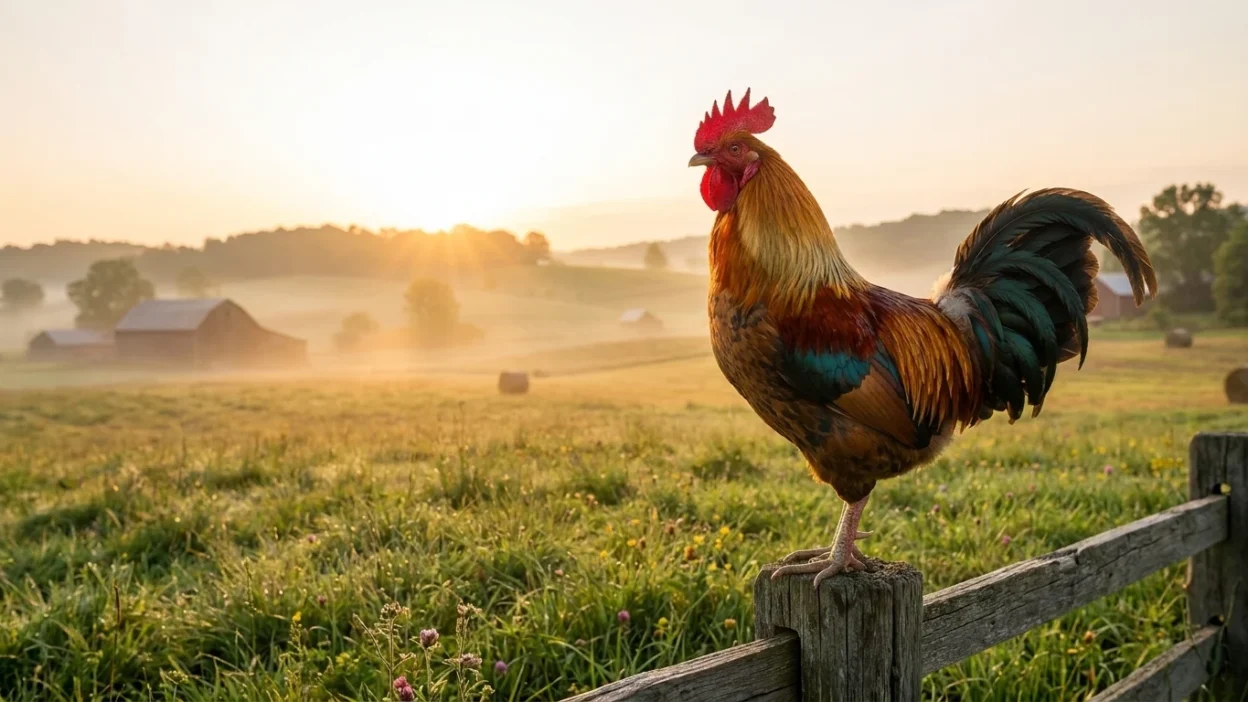
Rooster symbolism is strongly connected with confidence, courage, awakening, vigilance, leadership, pride, and new beginnings. For centuries, the rooster’s distinctive crow at dawn has made it a natural symbol of waking up, announcing change, and welcoming a new day.
A rooster can represent the courage to make your presence known, the confidence to speak your truth, or the awareness needed to recognize opportunities before they pass. Its bold appearance and assertive behavior also give it associations with leadership, independence, strength, and personal identity.
Whether a rooster appears in a dream, spiritual experience, cultural tradition, or everyday life, its symbolism often carries a message about becoming more aware and confident. It encourages you to stand tall while remaining responsible for how you use your influence.
Rooster Symbolism Meaning (Clear Definition)
Rooster symbolism represents confidence, courage, vigilance, leadership, awakening, pride, communication, protection, and new beginnings. Because the rooster traditionally announces the arrival of dawn, it is especially associated with awareness, renewal, and the transition from darkness to light.
Its symbolism can be positive or cautionary. A confident rooster may represent healthy self-belief, while an overly aggressive or boastful rooster can symbolize arrogance, ego, or the misuse of authority.
Rooster symbolism in one simple definition
Rooster symbolism means awakening, confidence, courage, leadership, vigilance, communication, and the strength to step into a new beginning.
The meaning can change according to the rooster’s behavior and the circumstances in which it appears.
What Does Rooster Symbolism Represent?
Rooster symbolism contains several powerful themes that relate to personal growth, spirituality, relationships, and everyday life.
| Rooster Symbolism | Common Meaning |
|---|---|
| Confidence | Believing in yourself and your abilities |
| Courage | Facing challenges without retreating |
| Awakening | Becoming aware of truth or opportunity |
| Vigilance | Staying alert and observant |
| Leadership | Taking responsibility and guiding others |
| Pride | Healthy self-respect or excessive ego |
| Communication | Speaking clearly and making yourself heard |
| Protection | Defending family, territory, or values |
| Renewal | Beginning a fresh chapter |
| Independence | Standing confidently on your own |
Confidence and self-expression
The rooster is rarely associated with hiding. Its posture, appearance, and crow make it an obvious symbol of visibility and self-expression.
Rooster symbolism may appear when you need to stop minimizing yourself. It can encourage you to recognize your abilities and communicate your ideas with greater confidence.
Courage and bravery
A rooster can symbolize courage because it boldly announces its presence and may defend its territory against rivals.
Symbolically, this represents the willingness to face challenges rather than allowing fear to make every decision for you.
Vigilance and awareness
Roosters are associated with alertness. Their crow signals the beginning of the day, making them natural symbols of staying awake to what is happening around you.
This meaning can serve as a reminder to notice warning signs, opportunities, changing relationships, and your own instincts.
Leadership and responsibility
The rooster’s commanding presence gives it strong leadership symbolism. It can represent taking initiative and accepting responsibility rather than waiting for someone else to act.
True leadership, however, is not simply about being loud. Rooster symbolism can encourage confident action combined with awareness and responsibility.
Pride and ego
Pride is one of the rooster’s most obvious symbolic qualities. Healthy pride can mean self-respect and confidence, but excessive pride can become arrogance.
The rooster therefore offers a useful lesson: stand tall without believing you are above everyone else.
Spiritual Meaning of Rooster Symbolism
The spiritual meaning of rooster symbolism centers on awakening, divine awareness, courage, vigilance, renewal, protection, and the movement from darkness toward light.
The rooster’s connection with sunrise gives it an especially powerful spiritual role. Dawn represents a transition, and the rooster’s call can symbolize the moment when something hidden becomes visible.
Rooster as a symbol of awakening
A rooster crowing at dawn can represent spiritual awakening or increased awareness.
You may be entering a period when an important truth is becoming clearer. Something you previously ignored may suddenly demand your attention.
Rooster as a symbol of new beginnings
Every sunrise creates a natural image of renewal. The rooster announces that the night has ended and another day has begun.
Spiritually, this can represent a second chance, a fresh perspective, or the courage to begin again after disappointment.
Rooster as a symbol of vigilance
Spiritual growth often requires awareness. Rooster symbolism encourages you to remain conscious of your thoughts, choices, surroundings, and relationships.
Its message can be especially meaningful when you are moving through a period of uncertainty.
Rooster as a symbol of personal power
A rooster does not need to imitate another bird to make itself heard. This can symbolize authentic self-expression.
Its spiritual lesson may be to recognize your own voice instead of constantly comparing yourself with others.
Rooster as a protector
In symbolic traditions, the rooster can represent a guardian who notices danger and announces its presence.
This protective quality can apply to your family, personal boundaries, values, or spiritual path.
Biblical / Religious Meaning of Rooster Symbolism
Rooster symbolism has an important place in Christian tradition, particularly through the biblical story of Peter’s denial of Jesus.
According to the Gospel accounts, Jesus tells Peter that before the rooster crows, Peter will deny knowing him three times. After Peter denies Jesus, the rooster’s crow becomes a moment of recognition and remorse.
The rooster and Peter’s denial
The rooster’s crow is therefore associated with awareness, prophecy, repentance, and recognition of truth.
Peter’s experience also shows that recognizing a mistake does not have to be the end of a person’s story. Awareness can become the beginning of change and restoration.
Rooster symbolism and vigilance
The rooster’s connection with dawn also supports themes of watchfulness and spiritual awareness.
In Christian symbolism, light often represents truth and spiritual understanding, making the rooster’s morning call a natural image of awakening.
Religious symbolism in other traditions
The rooster has symbolic importance in several cultures and religious traditions outside Christianity.
In some traditions, the rooster is connected with the sun, fertility, protection, sacrifice, timekeeping, or the victory of light over darkness. In Chinese culture, the Rooster is also one of the twelve zodiac animals and carries associations with confidence, honesty, punctuality, and observation.
Because religious symbolism varies widely, the meaning of a rooster should always be considered within its particular cultural context.
Rooster Symbolism in History and Culture
Roosters have been closely connected with human communities for thousands of years. Their predictable crowing made them natural timekeepers before modern clocks became widespread.
The rooster’s connection with sunrise helped establish its symbolic relationship with time, discipline, vigilance, renewal, and daylight.
Ancient cultures
In ancient Mediterranean traditions, roosters were sometimes connected with gods and figures associated with the sun, fertility, war, or healing.
Their crowing at dawn gave them a special relationship with the daily return of light.
Chinese culture
The Rooster is the tenth animal in the Chinese zodiac. Traditional interpretations commonly associate the Rooster with confidence, punctuality, honesty, intelligence, observation, and determination.
The symbolism can also include pride and directness, reflecting the bird’s strong personality.
Japanese culture
Roosters have appeared in Japanese religious and cultural imagery, including traditions surrounding the sun goddess Amaterasu.
The rooster’s crow is associated with the return of light and can therefore represent hope, awakening, and renewal.
European traditions
In European folklore and heraldry, the rooster has often represented courage, vigilance, pride, and national or communal identity.
The image of a rooster on a weather vane also became a familiar symbol of watchfulness and changing conditions.
Rooster Symbolism in Literature and Art
Roosters have appeared in literature, paintings, religious art, folklore, heraldry, poetry, and decorative traditions.
Artists often use the rooster to represent pride, masculinity, confidence, vigilance, time, awakening, or rural life.
In religious art, the rooster is particularly associated with Peter’s denial and the themes of remorse and spiritual recognition.
In folklore, the rooster can be portrayed as a clever, courageous, boastful, or protective character. These contrasting portrayals reflect the bird’s complex symbolic nature.
The rooster’s colorful feathers and distinctive posture also make it visually powerful. Artists can use its appearance to communicate energy, confidence, and movement even without words.
In modern storytelling, a rooster may represent someone who wants attention or someone who is unafraid to speak. Its symbolic personality often reflects the human tension between healthy confidence and excessive pride.
Dream Meaning of Rooster Symbolism
Dreaming about a rooster can symbolize confidence, awakening, communication, leadership, vigilance, competition, or a need to pay attention to something important.
The rooster’s behavior and your emotions in the dream are important clues.
Dreaming of a crowing rooster
A crowing rooster may symbolize an announcement, warning, awakening, or important realization.
It can suggest that something in your waking life deserves your immediate attention.
Dreaming of a colorful rooster
A colorful and healthy rooster may represent confidence, creativity, visibility, success, and self-expression.
It can be a positive reminder to show more of your personality instead of staying in the background.
Dreaming of an aggressive rooster
An aggressive rooster may represent conflict, competition, anger, or an overly dominant personality.
The dream may be encouraging you to establish boundaries or reconsider how you respond to confrontational people.
Dreaming of a rooster chasing you
Being chased by a rooster can symbolize pressure from someone who is demanding attention or trying to dominate a situation.
It may also reflect your own fear of taking responsibility or being seen.
Dreaming of a dead rooster
A dead rooster can symbolize the end of a period of confidence, leadership, conflict, or personal identity.
It may also represent the need to leave behind an outdated version of yourself before beginning a new chapter.
Dreaming of several roosters
Multiple roosters may represent competition, arguments, conflicting opinions, or several people trying to take control.
Alternatively, they can symbolize a strong social environment where confidence and communication are important.
Modern Meaning of Rooster Symbolism
Today, rooster symbolism continues to represent confidence, independence, leadership, awareness, communication, courage, and personal identity.
The rooster’s image is frequently used in logos, sports imagery, decorative art, cultural celebrations, and rural design because its appearance naturally communicates strength and character.
Rooster symbolism and confidence
Modern life often rewards people who can communicate their ideas clearly. The rooster can therefore symbolize the confidence needed to speak up and make your presence known.
However, its message is not simply to be louder. Genuine confidence means knowing your value without needing to diminish anyone else.
Rooster symbolism and discipline
Because roosters are associated with dawn and regular routines, they can symbolize discipline and consistency.
The symbolic lesson is that meaningful progress often comes from showing up repeatedly rather than waiting for motivation.
Rooster symbolism and leadership
The rooster represents a form of leadership based on visibility and initiative.
If you are avoiding responsibility, its symbolism may encourage you to take action. If you already have influence, it can remind you to use that influence responsibly.
The shadow side of rooster symbolism
The rooster also has a cautionary side.
It can represent:
- Arrogance and excessive pride
- Aggression or unnecessary competition
- Attention-seeking behavior
- Stubbornness
- Overconfidence
- Dominating conversations or relationships
These meanings can be useful because they encourage balance. Confidence is powerful when it is supported by humility and awareness.
Frequently Asked Questions About Rooster Symbolism
What is the main meaning of rooster symbolism?
Rooster symbolism commonly represents confidence, courage, awakening, vigilance, leadership, communication, pride, and new beginnings.
What does a rooster symbolize spiritually?
Spiritually, a rooster can symbolize awakening, awareness, protection, courage, renewal, and the movement from darkness toward light.
Is seeing a rooster a good spiritual sign?
A rooster can be interpreted as a positive sign when it represents awakening, confidence, courage, or a new beginning. Its meaning depends on your circumstances and the feelings associated with the encounter.
What does dreaming about a rooster mean?
Dreaming about a rooster may represent confidence, communication, leadership, competition, or an important warning. A crowing rooster can particularly symbolize awakening or an announcement.
What does a rooster symbolize in Christianity?
In Christianity, the rooster is strongly associated with Peter’s denial of Jesus and therefore with awareness, remorse, repentance, and recognition of truth.
Conclusion
Rooster symbolism is ultimately about waking up, standing tall, and finding the courage to use your voice. Its connection with dawn makes it a powerful symbol of renewal, while its bold behavior represents confidence, vigilance, leadership, and self-expression.
Yet the rooster also teaches balance. Confidence becomes meaningful when it is joined with humility, and leadership becomes valuable when it protects rather than dominates.
The rooster’s message is clear: awaken to your potential, speak with courage, remain alert, and step confidently into each new day.

Gabriel Santiago is a dedicated writer and symbolism researcher at BibloSign.com, passionate about exploring symbol meanings, cultural traditions, spiritual interpretations, and historical significance to help readers better understand the world of symbolism.